
In 1984, an outbreak of thyrotoxicosis was observed among residents of southwestern Minnesota and the surrounding areas of South Dakota and Iowa. The source of the affliction, dubbed “hamburger thyrotoxicosis,” was traced back to the consumption of ground beef prepared from gullet trimmings processed by a single slaughtering plant. This was later confirmed by findings of bovine thyroid tissue in the trimmings as well as the observation of sudden increases in serum thyroid hormone concentrations in volunteers who ate the ground beef from this plant. The thyroid gland tissue of cattle produces T3 and T4, known as thyroxine and triiodothyronine respectively, which are also relatively heat-stable so that after being ground into hamburger by gullet trimming, these hormones also survived cooking. After consumption, these thyroid hormones are absorbed through the small intestine, enter the circulation and are biologically active. The hormone excess in the body’s bloodstream leads to clinical signs of hyperthyroidism such as nervousness, sleeplessness, weight loss, and fatigue. The USDA later banned the practice of gullet trimming for human food consumption in 1986. Interestingly, gullet trimming is not banned for pet food and the same condition, caused by consuming thyroid tissue, can arise in animals. This outbreak highlighted how butchering practices can have major health consequences, leading to stricter food safety standards to protect consumers.
Category: Articles
-

Molecular Fingerprinting Used by Disease Detectives
New York City’s South Bronx was the center of the largest outbreak of Legionnaires’ disease in the city’s history in 2015. Legionnaires’ disease—a sometimes lethal agent causing pneumonia—is caused by Legionella bacteria, which are commonly found in warm water systems like cooling towers and plumbing. Traditional public health investigations relied on a laboratory method called pulsed-field gel electrophoresis (PFGE) to match bacterial DNA from patients with potential environmental sources. However, PFGE lacks the precision to identify and resolve closely-related, but not identical, strains of Legionella. In this outbreak, Dr. Kim Musser used Whole-genome sequencing (WGS) as a molecular “fingerprint” to link a cooling tower to patient strains. She had developed molecular methods while working in the Wadsworth Center—New York State’s public health laboratory. In WGS, bacterial DNA is sheared, barcoded and identified, sequenced, and then analyzed via computational methods. WGS is a highly discriminatory method that can detect single nucleotide differences, allowing scientists to accurately pinpoint the source of outbreaks. During this Legionnaires’ outbreak in the Bronx, working with Don Weiss, the source was confirmed as a contaminated cooling tower when genetically identical Legionella bacteria matched between patients and the suspected cooling tower.
Another advanced molecular method used in this Legionnaires’ disease outbreak was polymerase chain reaction (PCR). PCR detects the presence of specific genetic material by amplifying DNA present in the sample with DNA primers specifically designed to detect the organism of interest. Although PCR can identify the presence and relative quantity of a pathogen, it does not provide a sequence analysis to link organisms between disparate sources—any permutation of patient and environmental sources. Dr. Musser continues to advance molecular methods, such as RNA baiting to extract DNA from clinical specimens rather than having to grow the bacteria on culture media.
Citations
https://pmc.ncbi.nlm.nih.gov/articles/PMC5349490/pdf/10.1177_0033354916689620.pdf
https://pmc.ncbi.nlm.nih.gov/articles/PMC11005328/pdf/jcm.01305-23.pdf
-

Ruth Rothstein—Effective Advocate
In Wind Beneath Their Wings: Improving a County Health System, Caryn Stancik and Elizabeth Reidy describe their work as the Chief Communications Officer and General Counsel for a large and expanding government-run urban health system. They credit Ruth Rothstein, former CEO of the Cook County Hospital, for establishing a culture that promoted women into leadership positions. Rothstein had a remarkable life, progressing to CEO of Mt. Sinai Hospital in Chicago and Cook County Hospital by demonstrating competence and an unwavering belief in justice. Her noteworthy accomplishments included building a new hospital to replace the old Cook County Hospital, acquiring funding for the eponymous Ruth Rothstein Core Center to provide HIV-AIDS care, and expanding the ambulatory clinic network to provide longitudinal healthcare. At Mt. Sinai Hospital, after being denied a job in medical administration because she did not have a college degree, Rothstein refused a secretarial position saying “I don’t type”. Her humor is evident when under a photograph of her with Golda Meir, the caption was added, “But can she type?”
https://commons.wikimedia.org/wiki/File:Cook_County_Hospital.jpg, Jeff Dahl
-

The Tylenol Murders: Their Impact on Packaging
The Chicago Tylenol murders in 1982 were a cataclysmic crime that drove development of tamper-evident packaging. The series of deaths were caused by poisoning from potassium cyanide being laced in Tylenol-branded acetaminophen capsules. At least seven deaths resulted from this crime. While a suspect was never charged for the poisonings, a man named James Lewis was convicted of extortion for having sent a letter to Johnson & Johnson in which he took responsibility for the deaths and demanded $1 million from the company. Johnson & Johnson ultimately recovered from the scare and reintroduced Tylenol capsules in a triple-sealed package to prevent tampering, marking the beginning of many changes in how medications were packaged.
In 1983, Congress passed the Federal Anti-Tampering Act, also dubbed the “Tylenol Bill,” which made it a felony to tamper with consumer products. The FDA also updated their policy in 1989 to make medications more resistant to tampering, requiring tamper-evident seals on over-the-counter medications. This also led to the manufacturing of medication dosage forms transitioning from capsules to modern caplets. Some capsules can be opened to access the medication inside, whereas the same cannot be done for caplets because they have a film or gelatin coating that cannot easily be modified without leaving behind evidence of tampering.
The goal is not to make packaging completely “tamper-proof,” as considering that since the buyer must access the medication themself, this is nearly impossible. Instead, packaging design has evolved so that any interference with the container would be obvious to the buyer, discouraging them from buying or using the product. The triple-sealed package that Johnson & Johnson debuted after the Tylenol murders is one example. Most modern over-the-counter medications now reflect this triple-seal package, adopting a plastic shrink around the cap, a foil or paper seal glued to the bottle mouth and a breakaway cap. These simple but effective features have become a standard in modern pharmaceuticals by functioning as a safeguard for the integrity of the medication and the consumer’s health.
-

A Doctor’s Life in Correctional Healthcare, Dr. Jack Raba
In this two-part episode of Inspired to Heal, “Healthcare Behind Bars,” host Bill Trick speaks with Dr. Jack Raba, whose medical career found itself intertwined with Cook County’s correctional system at many points in his life. He volunteered during high school, where he sat with patients to hear their stories. While studying to be a priest, he worked with a family near the hospital and felt a calling to leave the seminary and go to medical school to heal people differently. After medical school, he chose to train at Cook County Hospital, where Dr. Raba observed suboptimal facilities for patient care. He became the president of the Cook County house staff doctors’ union and within two months, the union provided a list of demands for their contract; nearly all centered around improving conditions for patient care. After Dr. Raba and several other doctors went on strike, six of them—one of them being Dr. Raba—were sent to jail. After his release, Dr. Raba found himself on the other side of the bars as the medical director of Cook County Jail, where he implemented several important public health initiatives around control of communicable diseases, such as tuberculosis, and recognized and exposed police violence.
Dr. Raba’s choice to put two items in his doctor’s bag: elimination of the cash bond and treatment, rather than incarceration, for substance use. He spoke of seeing inmates housed for long periods of time in Cook County Jail for nonviolent crimes who could not post cash bail and how this disproportionately punished poor people. Rather than incarcerate individuals for drug offenses, the money should be used towards behavioral health treatment for substance use disorders or mental health conditions; it costs roughly $45,000 per year to incarcerate an individual. Approximately 44% of jail inmates have a mental illness compared to 18% of the general U.S. population. Thus, the three largest mental health facilities in the U.S. are jails—Cook County Jail being one of these three. Dr. Raba’s life work in correctional healthcare demonstrates how one individual, leading a dedicated team of healthcare workers, can meaningfully impact the lives of many people. His compassion and humility shine through in this interview.
-

Laryngoscopy: From Head Mirrors to Fiberoptics
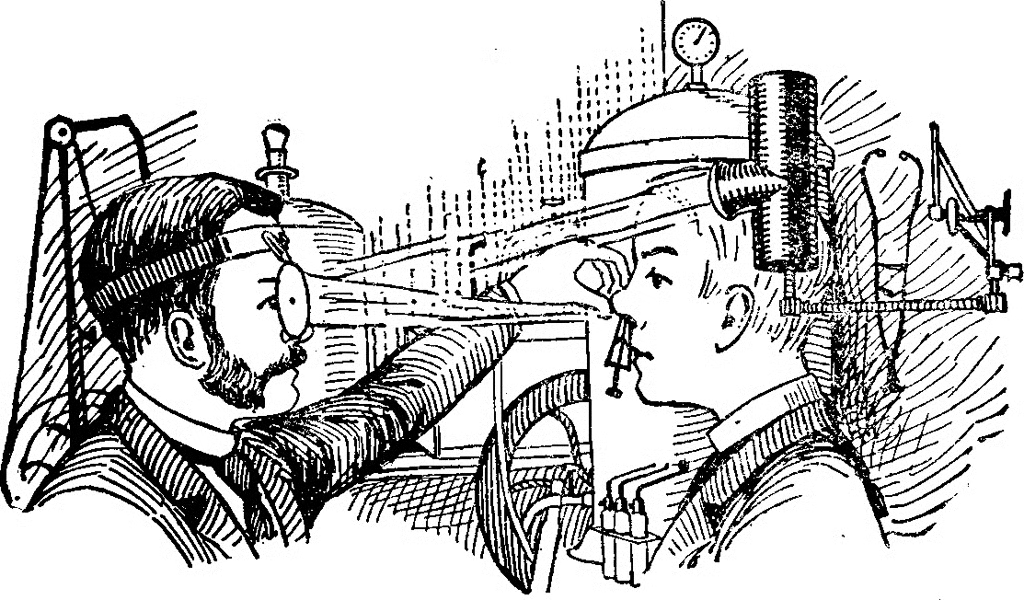
For the episode “Essential Items for your Medical Bag”, Inspired to Heal compiled a montage of guests’ responses to the question: “If you could choose one item to put into your medical bag, literal or figurative, what would it be?” Most responses were figurative—but what might the literal contents be? The items in a medical bag evolved over time. The now defunct mirror affixed to a doctor’s forehead, as mentioned in Peter Clarke’s response, is one of the most notable tools that speaks to this evolution. Before modern fiberoptic scopes, doctors relied on mirrors and rigid instruments to see inside the body. As a precursor to the doctor’s forehead mirror, in 1854—Manuel García, a Spanish singing teacher, used a dental mirror and sunlight reflected from a hand mirror to visualize his own vocal cords. His curiosity laid the foundation for the use of mirrors to visualize the throat, also known as laryngoscopy. Johann Czermak modified the process by using a light source concentrated by a concave mirror; thus, avoiding the wait for a sunny day. However, instruments that arose from this observation, like the laryngeal mirror and esophageal specula, required intense lighting and precise angles.
In 1957, Dr. Basil Hirschowitz refined fiberoptic technology and in the spirit of Manuel Garcia, visualized his own vocal cords, and subsequently, a patient’s throat was examined days later. The key innovation was the use of flexible glass fibers, which could transmit light through bends and curves, using the principle of total internal reflection. This principle describes how light travelling through a medium encounters a boundary with a less dense medium and is then reflected back into the original medium. In short, bundles of these fibers carry light into the patient’s body and return a visual image back to the physician’s eyepiece. Hirschowitz used coherent fiber bundles; each fiber stayed in the same relative position from one end to the other, allowing a clear image to form. He, along with physician Larry Curtiss, invented a flexible, steerable endoscope, leading to clearer and more comfortable visualization of the esophagus and stomach—something rigid scopes of the past failed to accomplish. These advances in fiberoptics improved comfort for patients and gave doctors a more detailed view of patients’ internal structures in real time, revolutionizing modern diagnostics and minimally invasive procedures.
-

Will Consumer Safety Survive Partisan Pandering?
In 1972, during Richard Nixon’s Presidency, Congress overwhelmingly passed the consumer product safety bill with bipartisan support—87% of Senators voted “Yea” (Figure). As a result, an intentionally independent, bipartisan federal regulatory agency entity was formed, The U.S. Consumer Product Safety Commission (CPSC). To minimize political interference, no more than three of the five commissioners can be affiliated with a single political party. The CPSC has played a critical role in the protection of consumers, frequently children, from products that result in serious injury and death. Think of defective pool drains, small coin batteries, and lead-coated toys. The current bill intends to move the agency into the Department of Health and Human Services—compromising its independence.
Perhaps Gabe Knight, Consumer Reports senior safety policy analyst, said it best through a press release:
“Simply put, shortsighted plans to dismantle the nation’s long-standing product safety watchdog will make everyone less safe. Whether they’ve heard of the agency or not, Americans depend on the CPSC every day. If this agency is eliminated, we will be left to face a more dangerous marketplace, and suffer from increased exposure to hazardous products that can injure or kill. Consumer Reports calls on Congress to assert itself, reject this budget request, and defend the agency it created and has supported for more than fifty years.”
References: All accessed July 1, 2025